
University
AI in Business Degree Journey
I’m studying BSc AI in Business through IU University’s distance learning program, which combines machine learning, natural language processing, predictive analytics, and business intelligence with the flexibility to apply concepts in real‑time. The curriculum integrates quantitative methods and algorithmic foundations with corporate finance, strategic management, and AI governance, preparing me to leverage AI capabilities through an in‑depth understanding of the underlying systems.
Read More
The program goes far beyond surface‑level AI concepts to build genuine technical competency. In modules like Deep Learning in Business Contexts, I’m learning the mathematical foundations behind neural networks and how different architectures solve specific business problems – not just how to use pre‑built models, but understanding when and why certain approaches work. The NLP components cover everything from tokenisation and semantic analysis to building custom language models, giving me the ability to create solutions rather than just implement existing ones.
What sets this degree apart is its focus on practical implementation within business constraints. The Corporate Finance and Investment modules teach me to evaluate AI projects through ROI analysis and risk assessment, while Ethics and Legal Aspects ensures I understand the regulatory landscape that governs AI deployment. Project modules like AI Product Commercialisation require me to take concepts from theory through to market‑ready solutions, dealing with real challenges like data quality, user adoption and scalability.
The curriculum also emphasises systems thinking – understanding how AI fits within broader organisational structures. Modules on Change Management and Process Automation prepare me to navigate the human and operational challenges of implementing AI, recognising that technical excellence means nothing if the solution can’t be adopted effectively. This comprehensive approach means I’m developing both the technical depth to build robust AI systems and the business acumen to ensure they create measurable value.

Why Online?
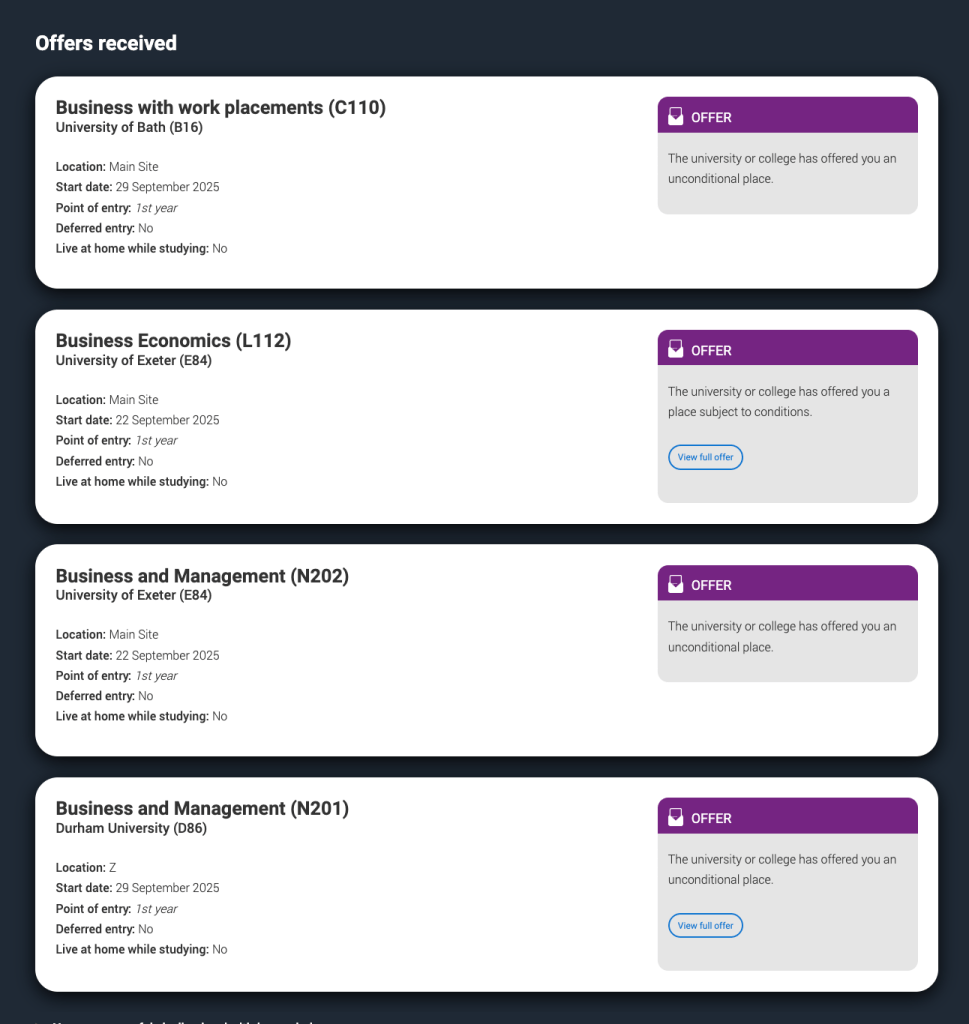
I had unconditional offers to study Business and Economics at several top UK universities including Bath, Durham and Exeter, and came very close to taking the traditional route. However, after running the numbers and thinking through what I actually wanted from my education, the online path made more sense for my goals. The financial advantage was significant – I can pay for my degree as I go through work rather than accumulating £50,000+ in debt. But more importantly, distance learning gives me the autonomy to direct my own educational timeline while building real‑world experience.
The means and style of education was also more effective for me – the ability to pause, rewind and go through lectures and content at my own pace and in my own style, with the help of external tools like NotebookLM, has proven far more effective than traditional classroom learning. Instead of spending three years in lecture halls, I can work on actual projects, travel, and apply what I’m learning immediately.
The traditional university experience – the social scene, rugby initiations, endless nights out – simply wasn’t appealing to me. I’d rather spend that time building something meaningful or experiencing different cultures. When I wanted the rugby experience, I moved to Sydney for a year, played for Eastern Suburbs, and built genuine friendships on the other side of the world. Online learning also means avoiding the disruptions that have plagued UK universities – staff strikes, overcrowded courses, and variable teaching quality. Instead, I get consistent access to course materials and can focus on learning rather than navigating institutional problems.
Degree Timeline
Interactive timeline showing completed, in‑progress and upcoming modules.
Earlier Courses/Modules

Jan 2025
Business 101
Businesses and their environment, types of organisations, management and structure of business, production of goods and services, marketing of products and services, management of labour, and accounting.
Gain an overview of how businesses operate, including the roles of marketing, operations, finance and human resources. Understand the interplay between internal management and the external environment and explore how different organisational structures impact decision‑making.: UniversityFeb 2025
Artificial Intelligence
The history of AI (developments, AI winters, expert systems), modern AI systems (narrow vs. general AI; application areas), reinforcement learning (Markov chains, value functions, Q‑learning), NLP basics (vectorising, common methods), and computer vision fundamentals.
Trace the evolution of artificial intelligence from early expert systems to modern machine learning. Learn the principles behind reinforcement learning and build simple Q‑learning agents. Get hands‑on with NLP and computer vision through practical exercises.: UniversityMar 2025
Principles of Management
Strategic planning frameworks, organisational behaviour theories and leadership models.
Examine classic and contemporary management theories, from Taylorism to modern agile methodologies. Apply leadership models to case studies and develop strategic plans for hypothetical organisations.: UniversityMay 2025
Intro to NLP
Key NLP concepts such as syntax, semantics, phonetics, vectorisation and modelling techniques.
Dive deeper into natural language processing by experimenting with tokenisation, stemming and lemmatisation. Build simple language models and explore embedding techniques like Word2Vec and transformers.: UniversityJun 2025
Intro to Academic Work
Research methods, citation styles, scholarly writing, and critical reading.
Learn how to conduct literature reviews, evaluate sources, and present arguments coherently. Practise citation using APA and Harvard styles and develop critical thinking through peer review exercises.: UniversityFuture Courses/Modules

In progress
Project: AI Excellence with Creative Prompting Techniques
Generative AI content creation, prompt engineering, and ethical considerations.
Experiment with large language models and discover how different prompting strategies influence output quality. Tackle ethical dilemmas in generative AI and design a prototype that uses creative prompting to solve a business challenge.: UniversityUpcoming
Advanced NLP: Generative AI in Business Applications
LLM architectures, evaluation metrics and domain‑specific case studies.
Explore state‑of‑the‑art natural language generation models and how to fine‑tune them for tasks such as summarisation, translation and sentiment analysis. Delve into evaluation frameworks and business case studies to understand the impact of generative AI on industries like marketing and customer support.: UniversityUpcoming
Deep Learning in Business Contexts: Predictive Analytics
Feed‑forward & convolutional networks, sequence models and forecasting pipelines.
Study the mathematical foundations of deep neural networks and build models for classification, regression and sequence prediction. Learn to apply CNNs, RNNs and LSTMs to business data, developing end‑to‑end pipelines for demand forecasting and risk assessment.: UniversityAuto‑updated from my course tracker.
Learning Highlights
A few key takeaways from my journey so far.
Neural Network Foundations
Built my first neural network from scratch and gained intuition into backpropagation and activation functions.
Feb 2025
Business Fundamentals
Analysed how organisational structure, marketing, and finance interact within a company.
Jan 2025
Data‑Driven Decision Making
Used predictive analytics on a real dataset to forecast demand and optimise resources.
Mar 2025
Other Reading & Continuous Learning
Beyond formal coursework, I’m continually expanding my knowledge through books and articles.
 Bernard Cripps